The Agronomy of Arroz Bomba (Oryza sativa japonica)
Bomba rice (Arroz Bomba) is an ancient, short-grain round cultivar originating from the coastal freshwater lagoon of Albufera in Valencia, Spain. Unlike ordinary long-grain rices that expand lengthwise, Bomba expands up to 200–300% in volume accordion-style across its width without bursting its cell walls.
This distinct physical resilience is governed by its starch profile: Bomba possesses an optimal balance of amylose (roughly 23-24%) and high structural pectin that allows it to absorb three times its volume in rich broth without collapsing into mush. This characteristic makes it the only grain capable of withstanding the vigorous boiling and slow drying required of true Valencian cookery.
The Holy Trinity of Ingredients: Traditional Valencian Standard
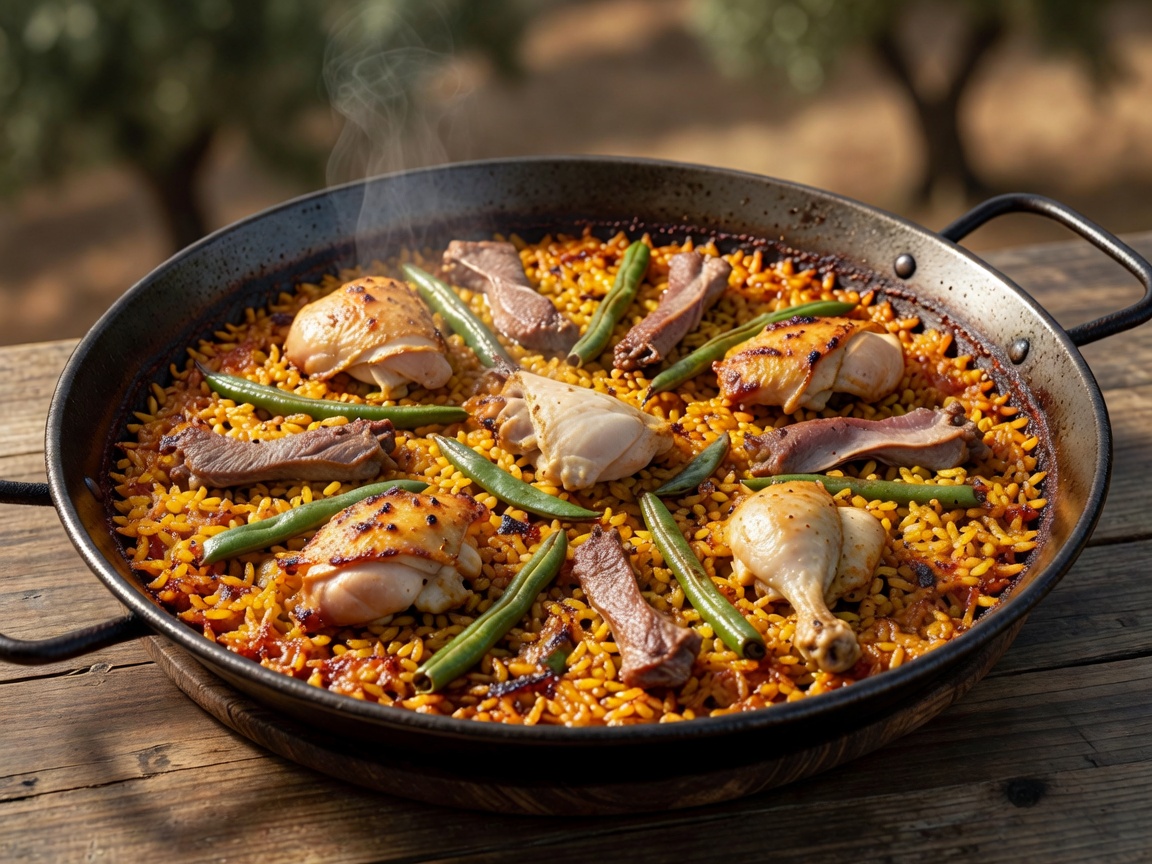
Contrary to the tourist seafood versions found in metropolitan centers, traditional inland Paella Valenciana consists strictly of:
- Arroz Bomba or Senia: Harvested under D.O. Arroz de Valencia regulatory protections.
- Meats: Free-range rabbit and farm chicken, browned until deep mahogany.
- Legumes: Bajoqueta (wide flat green beans) and Garrofó (creamy, giant white butter beans).
- Aromatics & Spices: Sweet smoked Pimentón de la Vera, freshly grated tomatoes, rosemary sprigs, and pure strands of bloomed Spanish Saffron (Azafrán).
The Physics of Socarrat
The crowning achievement of any paella master is the socarrat—the thin, highly aromatic, golden-toasted bottom crust formed against the carbon steel paellera pan. The creation of socarrat is governed by two complementary scientific transformations:
- Complete Liquid Desiccation: When all surface broth has fully penetrated into the grain cores, the heat transfers directly to the rendered fats and olive oil accumulated at the steel surface.
- The Maillard Reaction & Dextrinization: As the pan base reaches approximately 140°C to 165°C, residual proteins from the bone stock and starch sugars undergo thermal caramelization. The sound in the kitchen transitions from a wet bubbling to a crisp crackle.
To verify proper socarrat without burning, the cook gently presses the tip of a spoon against the pan bottom. A crisp, brittle resistance indicates success.